Short answer
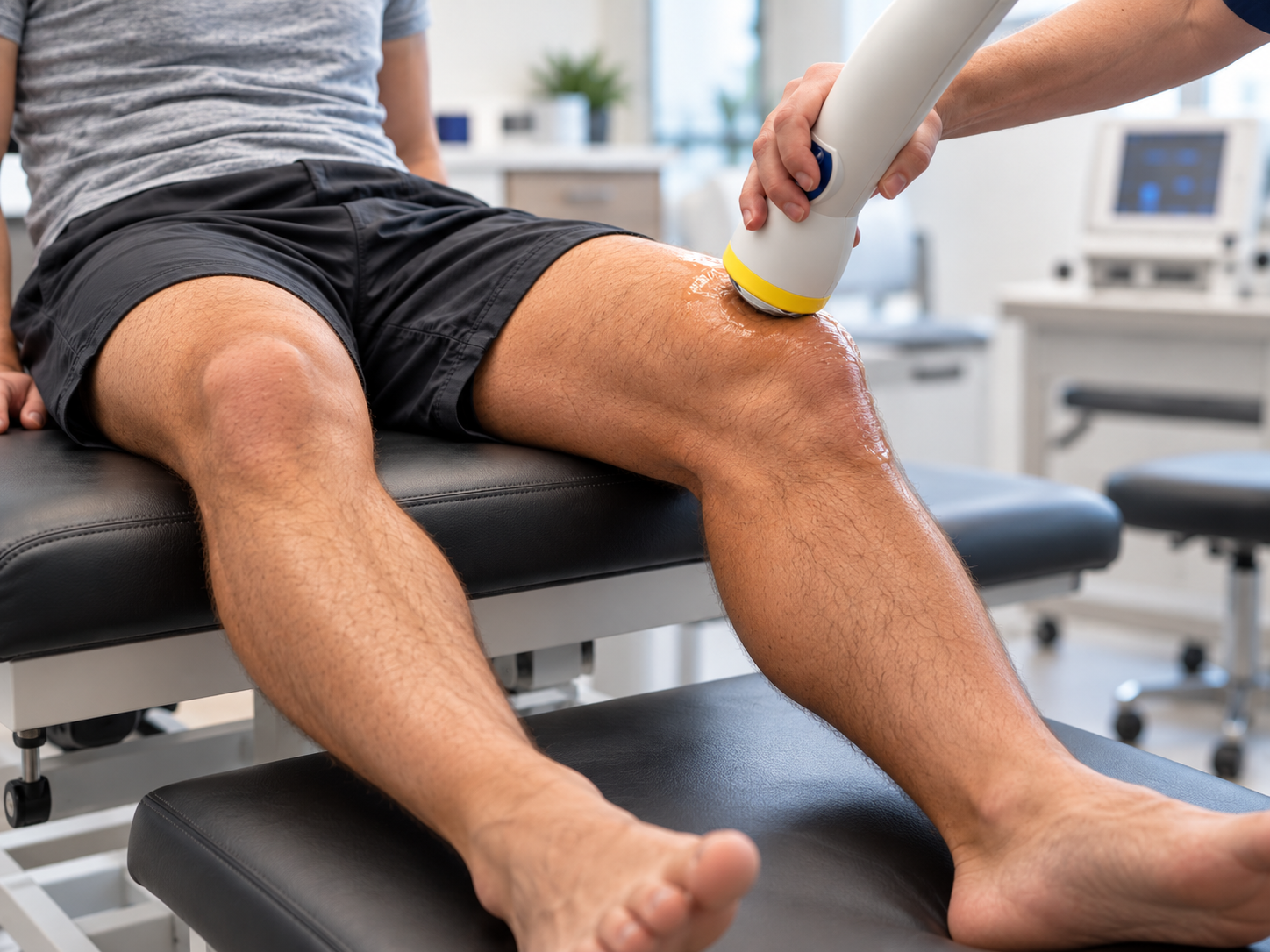
SoftWave is a brand of shockwave (acoustic-wave) therapy. A handheld applicator sends pulses of sound energy into sore tissue for about 10 to 15 minutes, with no needles, drugs or downtime. The device is FDA-cleared, and it is worth knowing what that clearance covers: temporary increase in local blood circulation, relief of minor aches and pains, and activation of connective tissue. It is not an FDA finding that the device cures any specific condition.
The research is condition-by-condition. For chronic plantar fasciitis, a meta-analysis of nine randomized trials found higher improvement rates with shockwave than with sham treatment. For knee osteoarthritis, a 2020 meta-analysis found reduced pain over 12 weeks. For rotator cuff problems, a 2020 Cochrane review found shockwave probably does not improve pain or function compared with placebo.
At Charleston Pain Relief Center in North Charleston, SC, we use SoftWave for the conditions where it has the best case, we re-evaluate after three visits, and we tell you plainly when something else is the better bet.
This article is general information, not medical advice for your situation. Do not stop or change a prescribed medication on your own — talk with whoever prescribed it first.
Pain Relief · North Charleston
What is actually causing your pain?
Text yourself the answer: what we would look at, what it costs, and this week’s openings. One tap, and the message is already written for you.
★ Your first 15 minutes are free
Prefer to talk? Call 843-604-2276

Scan it with your phone camera
The message is already written. Send it and we reply with the details.
On your phone right now? Call 843-604-2276
Where the research in this article comes from
We would rather you check our numbers than take our word for them. What the device is cleared for comes from the FDA’s 510(k) database, which lists the OrthoGold 100 we use. The condition-by-condition evidence comes from a 2017 meta-analysis of nine randomized trials in chronic plantar fasciitis, a 2020 meta-analysis of shockwave therapy in knee osteoarthritis, and a 2020 Cochrane review of 32 trials of shockwave for rotator cuff disease. Session details and candidate rules are from our own SoftWave service page. Full citations are at the end. From here on we will refer to them as the FDA record, the plantar fasciitis review, the knee review and the shoulder review.
What SoftWave is
SoftWave is the brand name of a shockwave device called the OrthoGold 100, made by Tissue Regeneration Technologies. “Shockwave” here means acoustic pressure waves, not electricity. The device generates the wave with an electrical spark inside a water-filled applicator and spreads it over a broad, unfocused field, which the manufacturer says reaches a wider and deeper area than the radial pressure-wave units found in many clinics. There are no needles, no medication and no anesthesia.
How shockwave therapy is thought to work
The honest answer is that the mechanism is not fully settled. Laboratory and animal studies suggest the pressure waves cause tiny mechanical stress in tissue that triggers a repair response: new small blood vessels, more collagen production, and changes in how pain-sensing nerve fibers behave. Manufacturers also describe recruitment of the body’s own repair cells to the treated area. Those are proposed mechanisms from lab work. What matters to you is whether people with your condition got better in controlled trials, which is what the sections below cover.
What “FDA-cleared” means here
This is worth a plain explanation, because the phrase gets used loosely. The OrthoGold 100 received FDA 510(k) clearance in May 2021 under the category “massager, therapeutic, electric.” Clearance in that pathway means the FDA found the device substantially equivalent to devices already on the market for three stated uses: a temporary increase in local blood circulation, relief of minor aches and pains, and activation of connective tissue. It does not mean the FDA reviewed trial data showing the device treats plantar fasciitis, arthritis or tendon injuries. The same device holds separate clearances for diabetic foot ulcers and second-degree burns, which are wound-care uses, not pain uses. We say this because we would want to know it if we were the patient.
Conditions we use SoftWave for, and what the trials show
Plantar fasciitis
This is the condition with the longest research record. The plantar fasciitis review pooled nine randomized trials (935 patients) comparing shockwave with sham treatment in chronic cases and found higher improvement rates with shockwave, with no serious adverse events reported. Two of the nine trials found no difference from sham, so the effect is not uniform, and the authors called for larger trials. Orthopaedic patient guidance describes the results as mixed and treats shockwave as a low-risk option to try before surgery. That is how we use it too: for heel pain that has outlasted stretching, footwear changes and rest. More on heel pain in our foot pain page.
Knee pain and knee arthritis
The knee review pooled randomized trials in knee osteoarthritis and found less pain at 4, 8 and 12 weeks compared with control, with no increase in adverse effects. The trials used different devices and doses, so a result from one machine does not automatically transfer to another, and none of them showed cartilage regrowth. For knee pain, we pair SoftWave with the basics that have the strongest evidence of all: exercise, strength work and weight management where it applies.
Tendon injuries: elbow, Achilles, patellar
Chronic tendon pain (tendinopathy) at the elbow, the Achilles and the kneecap is a common reason people come to us. Trials for these sites exist but are smaller and less consistent than the plantar fasciitis data, so we treat tendon work as reasonable to try with a clear checkpoint, not a sure thing.
Rotator cuff and calcific tendinitis: our most cautious use
We want to be direct about the shoulder, because shockwave is widely advertised for it. The shoulder review pooled 32 trials and 2,281 people with rotator cuff disease, with or without calcium deposits, and found moderate-certainty evidence that shockwave probably does not improve pain or function compared with placebo at three months, with more side effects in the shockwave group (26 in 100 versus 7 in 100, mostly pain and bruising). The reviewers found no difference between people with and without calcific deposits. If your main problem is a rotator cuff tendon, we will tell you that the evidence for shockwave is weak and talk through the alternatives before you spend anything.
What a SoftWave session is like
- About 10 to 15 minutes per area. Gel goes on the skin, the applicator is held against the sore spot, and you hear a tapping sound and feel a pulsing. Most people describe it as uncomfortable at worst, not painful, and the intensity can be turned down.
- Usually one session a week. Chronic problems typically take 5 to 8 sessions; newer injuries sometimes 3 to 5. We re-evaluate after the first three visits and adjust or stop.
- No downtime. You walk out and carry on with your day. Some people have mild soreness for about a day afterward.
- Often combined. Depending on your case we may pair it with Class IV laser therapy, hands-on care or an exercise program, sometimes in the same visit.
Who should not have shockwave therapy
We will not recommend it if you are pregnant (except, with physician clearance, for an arm or leg), have an active cancer at or near the treatment area, have an uncontrolled bleeding disorder, have an infection at the site, or have a pacemaker, which we evaluate case by case.
How SoftWave differs from symptom-management approaches
Pain medication and cortisone injections work on the pain signal or the inflammation around it, and both can be the right short-term call. Shockwave is aimed at the tissue itself, with the goal of starting a repair process that outlasts the sessions. That is the theory, and for plantar fasciitis and knee arthritis the trials give it some support. Two caveats keep us honest: the trials measure pain and function rather than proving the tissue healed, and for some body parts, the shoulder in particular, the controlled evidence is not there.
Frequently asked questions
Is SoftWave FDA-approved?
It is FDA-cleared, which is different from approved. The 2021 clearance covers temporary increase in local blood circulation, relief of minor aches and pains, and activation of connective tissue. It is not a finding that the device treats any specific condition.
Does shockwave therapy hurt?
Most people feel a tapping or pulsing sensation. Sore spots can be uncomfortable for a moment, and we can lower the intensity. Mild soreness for a day afterward is common.
How many SoftWave sessions will I need?
Typically 5 to 8 for a chronic problem, usually weekly. We reassess after three visits. If nothing has changed by then, we talk about plan B rather than selling you more sessions.
Does SoftWave work for rotator cuff pain?
The best available review says shockwave probably does not improve rotator cuff pain or function compared with placebo. We will tell you that at your evaluation and discuss what else might help.
Will insurance cover it?
Usually not. We post our pricing and accept HSA and FSA cards.
Where can I get SoftWave shockwave therapy near North Charleston?
Charleston Pain Relief Center is at 2294 Otranto Rd, North Charleston, SC 29406, serving North Charleston, Hanahan, Goose Creek, Ladson, Summerville, Park Circle and the wider Lowcountry. Call or text 843-604-2276.
Wondering if SoftWave fits your case?
Tell us what hurts and what you have already tried. Our North Charleston team will text you back with a straight answer about whether shockwave is a reasonable next step for you — and when it is not.
Sources
- U.S. Food and Drug Administration. 510(k) Premarket Notification K210451, OrthoGold 100, Tissue Regeneration Technologies, LLC; decision May 5, 2021 (product code ISA, Massager, Therapeutic, Electric). accessdata.fda.gov
- Sun J, Gao F, Wang Y, Sun W, Jiang B, Li Z. Extracorporeal shock wave therapy is effective in treating chronic plantar fasciitis: A meta-analysis of RCTs. Medicine (Baltimore). 2017;96(15):e6621. PMC
- The efficacy and safety of extracorporeal shockwave therapy in knee osteoarthritis: a systematic review and meta-analysis. Int J Surg. 2020;75:24–34. PubMed
- Surace SJ, Deitch J, Johnston RV, Buchbinder R. Shock wave therapy for rotator cuff disease with or without calcification. Cochrane Database Syst Rev. 2020;(3):CD008962. Cochrane summary
- American Academy of Orthopaedic Surgeons. Plantar Fasciitis and Bone Spurs. OrthoInfo. orthoinfo.org
- Charleston Pain Relief Center. SoftWave Shockwave Therapy in North Charleston, SC (service page, last updated October 2026). charlestonpainreliefcenter.com
Charleston Pain Relief Center · 2294 Otranto Rd, North Charleston, SC 29406 · 843-604-2276 · Last updated 24 October 2026. This article is educational and is not a substitute for individual medical advice. Do not start or stop any medication without speaking to your prescriber.