Short answer
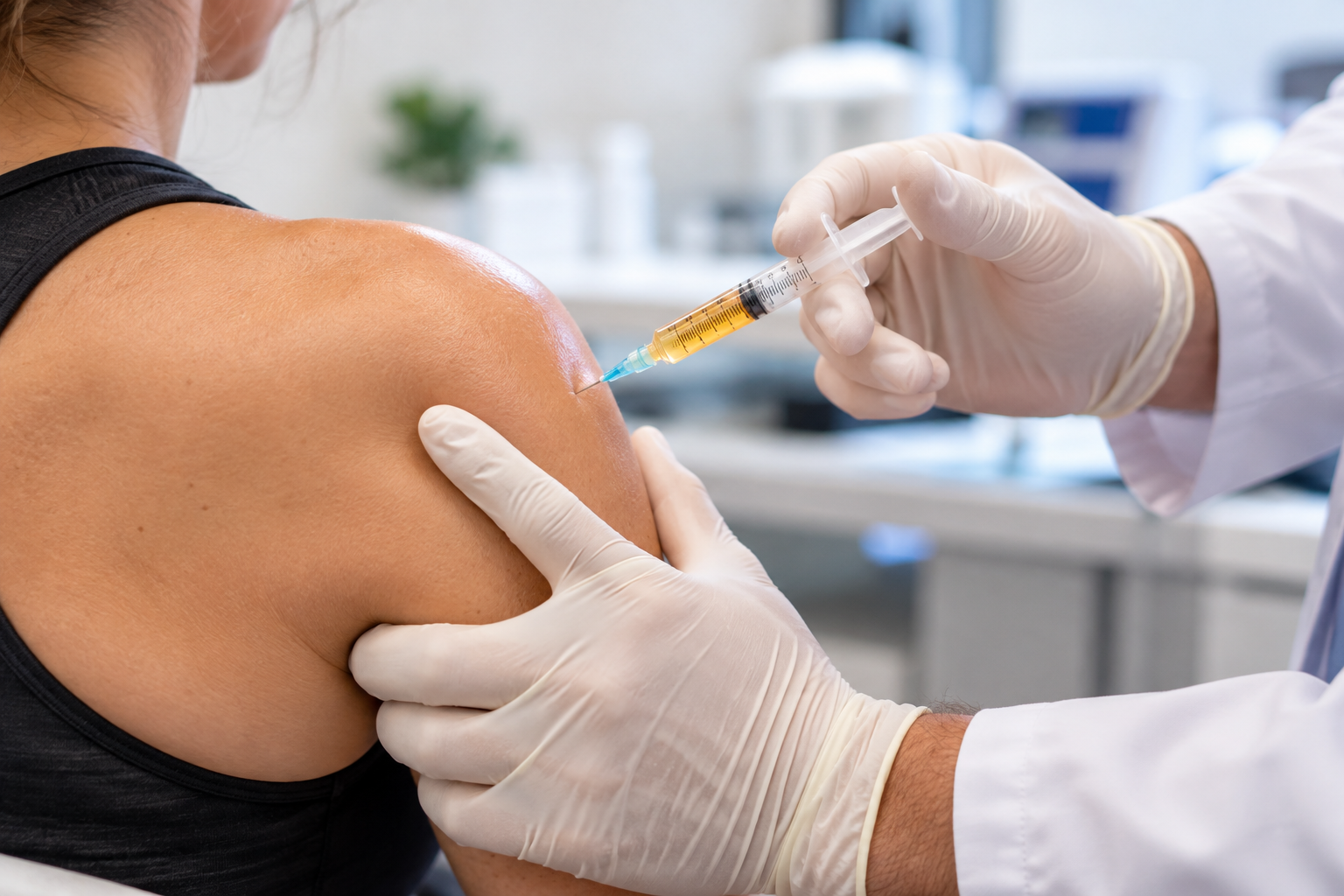
PRP (platelet-rich plasma) is made from your own blood. A small sample is spun in a centrifuge to concentrate the platelets, which carry growth factors involved in healing, and that concentrate is injected into the injured tendon or joint. The idea is to speed up a repair process that stalled. Laboratory studies support the idea; the clinical trials are mixed.
Here is the honest state of play. Orthopaedic patient guidance calls PRP effective for some chronic tendon injuries, especially tennis elbow, and reports growing support for mild-to-moderate knee arthritis. But the main U.S. arthritis guideline strongly recommends against PRP for knee osteoarthritis, a large 2021 trial found PRP no better than saline for knee pain or cartilage, and a Cochrane review found the evidence for soft tissue injuries insufficient. Risks are low; the main one is a sore joint for a week or two.
At Charleston Pain Relief Center in North Charleston, SC, we offer PRP, we post the price, and we tell you where the evidence is strong, where it is contested, and what questions to ask before you say yes.
This article is general information, not medical advice for your situation. Do not stop or change a prescribed medication on your own — talk with whoever prescribed it first.
Pain Relief · North Charleston
What is actually causing your pain?
Text yourself the answer: what we would look at, what it costs, and this week’s openings. One tap, and the message is already written for you.
★ Your first 15 minutes are free
Prefer to talk? Call 843-604-2276

Scan it with your phone camera
The message is already written. Send it and we reply with the details.
On your phone right now? Call 843-604-2276
Where the research in this article comes from
We would rather you check our numbers than take our word for them. The description of what PRP is and the orthopaedic view of where it works come from the American Academy of Orthopaedic Surgeons patient guide to PRP. The arthritis view comes from the 2019 American College of Rheumatology/Arthritis Foundation guideline, summarized for family doctors in American Family Physician, and from the 2021 RESTORE trial in JAMA. The soft-tissue view comes from a 2014 Cochrane review of 19 trials. Our process and pricing are from our own regenerative medicine page. Full citations are at the end. From here on we will refer to them as the PRP guide, the arthritis guideline, the knee trial and the Cochrane review.
What PRP is
Blood is mostly liquid plasma, with red cells, white cells and platelets suspended in it. Platelets are best known for clotting, but they also carry hundreds of proteins called growth factors that are involved in healing. PRP is plasma with far more platelets than usual, typically five to ten times the normal concentration, and therefore far more growth factors.
How your blood is processed
- A blood draw, like a routine lab test, usually from the arm.
- Centrifugation. The sample is spun at high speed so the components separate by weight, and the platelet-rich layer is drawn off. Different kits produce different mixes; one important variable is whether white blood cells are kept in (leukocyte-rich) or removed (leukocyte-poor), and research has not settled which is better for which condition.
- Injection into the injured tendon, ligament or joint, often with ultrasound guidance so the material lands in the right tissue.
The whole visit is usually under an hour, and you go home the same day. The pain at the injection site can get worse for the first week or two before any benefit appears, and it may be several weeks before you notice a change.
Where PRP is commonly used
- Chronic tendon injuries: tennis elbow, golfer’s elbow, Achilles tendinopathy, jumper’s knee, rotator cuff tendinopathy
- Knee osteoarthritis, especially mild to moderate
- Acute sports injuries such as hamstring pulls and knee sprains, where much of the publicity comes from
- During some surgeries, to try to improve healing
What the evidence shows, condition by condition
Tendon injuries
The PRP guide says PRP is effective for chronic tendon injuries, especially tennis elbow, and promising for Achilles and patellar tendon problems, though it is hard to say it beats standard treatment for those. The Cochrane review, which pooled 19 small trials of platelet-rich therapies for soft tissue injuries, rated the evidence very low quality and concluded there is not enough to support routine use. Both can be true: some individual trials are positive, and the overall body of evidence is thin.
Knee osteoarthritis: where experts disagree
This is the clearest case of expert disagreement in regenerative medicine, and we would rather lay it out than pick a side for you. The PRP guide reports a growing literature showing effectiveness in low- to moderate-grade knee arthritis, with some results lasting up to two years. The arthritis guideline, by contrast, strongly recommends against PRP and stem cell injections for knee osteoarthritis, citing safety concerns and a failure to show clinical benefit. The knee trial, which was placebo-controlled and blinded, randomized 288 adults with mild-to-moderate knee arthritis to three weekly injections of leukocyte-poor PRP or saline and found no significant difference in pain or cartilage volume at 12 months. The strongest-designed evidence leans negative; the orthopaedic community’s clinical experience leans positive. Part of the gap is that “PRP” is not one product, and a trial of one preparation does not settle the question for another.
Surgery and fractures
PRP added to rotator cuff repair or ACL surgery has shown little or no benefit, and it has shown no significant benefit for fracture healing.
Potential benefits and limitations
Benefits: it uses your own blood, so there is no risk of rejection; the complication rate (infection, tissue or nerve injury) appears no higher than for a cortisone shot; it does not carry cortisone’s tissue-weakening risk; and for the right tendon problem it may help when other things have not.
Limitations: the evidence is uneven and contested; preparations vary; few insurance plans cover it, so it is usually an out-of-pocket cost; injection-site pain is common for a week or two; and results, when they come, take weeks to months. PRP is not FDA-approved to treat any specific condition. The centrifuge kits are FDA-cleared devices, and the procedure is performed under the practice of medicine.
How we do PRP at CPRC
Our PRP therapy is listed on our regenerative medicine page as PRP plus bio-scaffolding, priced per joint per session, with the current price posted there. The injection is performed by our nurse practitioner, with image guidance where indicated. We tell patients that PRP responses commonly emerge over four to six weeks with continued change over three to six months, and we track patient-reported outcomes at 4, 8 and 12 weeks. If a joint has advanced arthritis with no remaining structure, we say so and refer you out. We also see many patients who have already had cortisone; our article on cortisone shots and NSAIDs explains why that matters.
Questions to ask before any PRP treatment
- What exactly is wrong with my tendon or joint, and what does the imaging show?
- What is the evidence for PRP in my condition, not PRP in general?
- Which PRP preparation do you use (leukocyte-rich or leukocyte-poor), and why?
- Will the injection be image-guided?
- What improvement should I expect, by when, and how will we measure it?
- What is the plan if it does not work, and what will it cost in total?
- Have I done the basics first: exercise, activity changes, and for the knee, weight management?
Frequently asked questions
Does PRP work for knee pain?
Experts disagree. Orthopaedic guidance reports growing support for mild-to-moderate knee arthritis; the main arthritis guideline strongly recommends against it; and the largest placebo-controlled trial found no benefit over saline. We lay that out before you decide.
Does PRP work for shoulder pain?
It has support for some chronic tendon problems and little or no benefit when added to rotator cuff surgery. For a partial tear or tendinopathy that has not responded to exercise, it is reasonable to discuss.
Is PRP safe?
The risks are low and comparable to a cortisone injection. Expect a sore joint for a week or two.
How long does PRP take to work?
Weeks, not days. We tell patients to expect changes over four to six weeks and continued change for several months.
Is PRP covered by insurance?
Rarely. Check with your carrier before booking anywhere.
Where can I get PRP therapy near North Charleston?
Charleston Pain Relief Center is at 2294 Otranto Rd, North Charleston, SC 29406, serving North Charleston, Hanahan, Goose Creek, Ladson, Summerville, Park Circle and the wider Lowcountry. Call or text 843-604-2276.
Thinking about PRP? Get a straight answer first.
Tell us what hurts, what the imaging shows if you have any, and what you have already tried. Our North Charleston team will text you back with a candid read on whether PRP makes sense for you — and the cost up front.
Sources
- American Academy of Orthopaedic Surgeons. Platelet-Rich Plasma (PRP). OrthoInfo. orthoinfo.org
- Kolasinski SL, Neogi T, Hochberg MC, et al. 2019 American College of Rheumatology/Arthritis Foundation Guideline for the Management of Osteoarthritis of the Hand, Hip, and Knee. Arthritis Care Res (Hoboken). 2020;72(2):149–162.
- Buelt A, Narducci DM. Osteoarthritis Management: Updated Guidelines from the American College of Rheumatology and Arthritis Foundation. Am Fam Physician. 2021;103(2):120–121. aafp.org
- Bennell KL, Paterson KL, Metcalf BR, et al. Effect of Intra-articular Platelet-Rich Plasma vs Placebo Injection on Pain and Medial Tibial Cartilage Volume in Patients With Knee Osteoarthritis: The RESTORE Randomized Clinical Trial. JAMA. 2021;326(20):2021–2030. PMC
- Moraes VY, Lenza M, Tamaoki MJ, Faloppa F, Belloti JC. Platelet-rich therapies for musculoskeletal soft tissue injuries. Cochrane Database Syst Rev. 2014;(4):CD010071. Cochrane summary
- Charleston Pain Relief Center. Regenerative Medicine in North Charleston, SC (service page, last updated October 2026). charlestonpainreliefcenter.com
Charleston Pain Relief Center · 2294 Otranto Rd, North Charleston, SC 29406 · 843-604-2276 · Last updated 24 October 2026. This article is educational and is not a substitute for individual medical advice. Do not start or stop any medication without speaking to your prescriber.