
Short answer
A herniated disc does not automatically mean surgery. In a 2007 randomized trial of 283 people with severe sciatica from a herniated disc, those who had surgery early got relief faster, but a year later they were doing about the same as people treated without early surgery. About 4 in 10 people assigned to non-surgical care still ended up having surgery during that year, so waiting is not a guarantee either.
Spinal decompression is one non-surgical option, and we offer it. We want to be straight with you: a 2013 Cochrane review of traction for low-back pain, the best summary of that research we could find, found little or no difference compared with sham or no treatment. Decompression is not a guaranteed fix and should not be sold as one.
At Charleston Pain Relief Center in North Charleston, SC, we start with an exam, tell you whether decompression makes sense for your case, and tell you plainly if you should be seen elsewhere.
This article is general information, not medical advice for your situation. Do not stop or change a prescribed medication on your own — talk with whoever prescribed it first.
Pain Relief · North Charleston
Get your back pain relief plan by text
One tap sends us a text that is already written for you. We reply with what we would look at, what it costs, and this week’s openings.
★ Your 15-minute consult is free
Prefer to talk? Call 843-604-2276

Scan it with your phone camera
The message is already written. Send it and we reply with the details.
On your phone right now? Call 843-604-2276
What is a herniated disc?
Between each pair of vertebrae sits a disc: a soft, gel-like center held in by a tougher outer ring. A herniated disc happens when part of that center pushes out through a weak spot in the ring. Terms like bulging, slipped and ruptured disc are often used loosely for the same problem. It can happen anywhere along the spine, but it is most often discussed in the lower back (lumbar spine) and the neck. For an overview of symptoms, diagnosis and treatment with illustrations, see the Cleveland Clinic guide to herniated disks.
Common herniated disc symptoms
- Low back pain (or neck pain, if the herniation is in the neck)
- Pain, numbness or tingling that travels into the buttock, leg and foot, usually on one side (into the arm and hand for neck discs)
- Weakness in a leg or foot
- Pain that changes with position or movement, such as sitting, bending, coughing or sneezing
Symptoms vary a lot from person to person, and similar symptoms can have other causes. That is why an exam matters.
How a herniated disc can cause back and leg pain
When disc material presses on or irritates a nearby spinal nerve root, that nerve can become inflamed. The pain then follows the path of the nerve, which is why a problem in the lower back can be felt in the leg. When the sciatic nerve is involved, it is called sciatica. You can read more about herniated discs and general back pain treatment on our site.
Red flags: get medical care right away
Most herniated discs are not emergencies. A few symptoms are. Go to an emergency room, and do not wait for an appointment, if back or leg pain comes with any of these:
- New loss of bladder or bowel control, or new trouble urinating
- Numbness or tingling in the “saddle” area (groin, buttocks, inner thighs)
- New sexual dysfunction along with back or leg pain
These can be signs of cauda equina syndrome, where the nerves at the base of the spine are compressed. It needs urgent treatment to prevent permanent damage. Rapidly worsening leg weakness also needs prompt medical evaluation. Mayo Clinic likewise lists worsening symptoms, bladder or bowel problems and saddle numbness as reasons to seek emergency care.
What is spinal decompression?
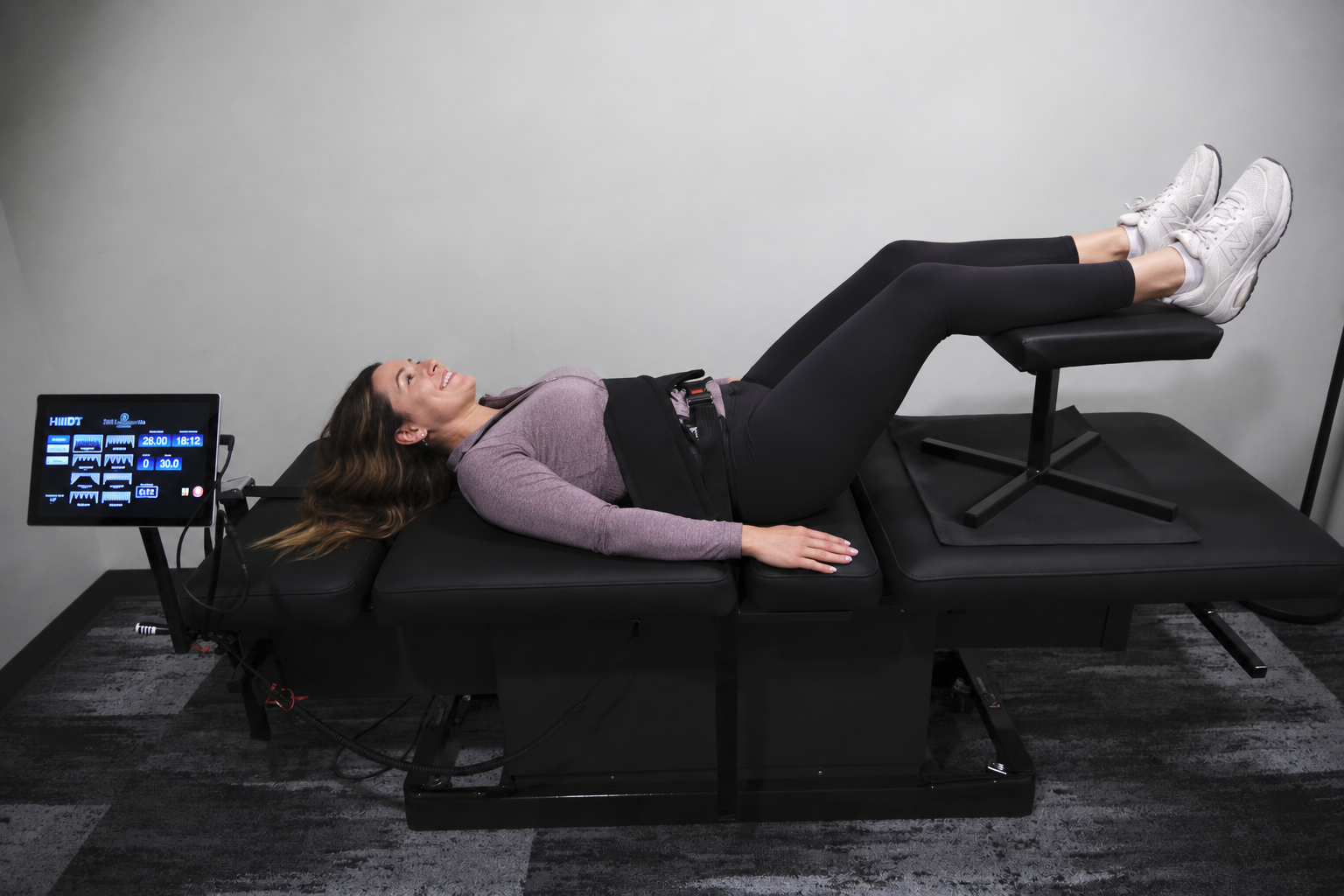
Non-surgical spinal decompression is a form of traction. You lie on a computer-controlled table, usually wearing a harness, and the table applies a gentle, controlled stretch in cycles of tension and relaxation. The idea is to ease pressure on the discs and on the nerves they may be pressing on. It is not surgery: there are no incisions and no anesthesia.
Whether that idea translates into real-world relief is the important question, so here is what the research says.
What does the research say about decompression and traction?
In 2013 the Cochrane Collaboration published a review of traction for low-back pain with or without sciatica. For people with back pain and sciatica, the authors found low- to moderate-quality evidence that traction probably has no impact on pain, function or overall improvement compared with placebo, sham traction or no treatment.
Two honest caveats. First, the review covered traction in general, not any single brand of table, and the trials in it vary in quality and technique, so it does not settle the question for every device or every patient. Second, an average across studies cannot tell you what will happen for you. What it does mean is that nobody should promise you decompression will fix a herniated disc. If a provider does, ask what they are basing that on.
Surgery vs non-surgical care: what one major trial found
In a randomized trial published in the New England Journal of Medicine in 2007, researchers followed 283 people who had severe sciatica from a herniated disc for 6 to 12 weeks. Half were assigned to early surgery (a microdiscectomy). The others were assigned to prolonged non-surgical care, with surgery if it was needed.
- Relief of leg pain was faster with early surgery.
- At one year, outcomes were similar between the two groups.
- Of 141 people assigned to early surgery, 125 (89%) had surgery. Of 142 assigned to non-surgical care, 55 (39%) ended up having surgery, on average after about 19 weeks.
So for many people, trying non-surgical care first was a reasonable path, and for those who wanted faster relief, surgery delivered it. The authors noted that the best timing for surgery was not known. This trial compared surgery with standard non-surgical care. It was not a test of spinal decompression tables.
When surgery may be considered
- Emergency signs such as the cauda equina symptoms above.
- Significant or worsening weakness in a leg or foot.
- Severe leg pain that has not settled with non-surgical care. The 2007 trial notes that disc surgery is often performed when sciatica has not resolved within about six weeks.
- Pain that is disabling, after you have weighed your options with a physician or spine surgeon.
Whether surgery is right for you is a medical decision, usually made with imaging and a surgeon. The American Academy of Orthopaedic Surgeons’ OrthoInfo page adds a caution in the other direction: patients who stay on non-surgical care for too long before choosing surgery may see less improvement than those who choose it earlier. How long is too long is a question for your doctor. If you have been told you need surgery, a second opinion is reasonable, and we are happy to help you work out what to ask.
Who may be a candidate for spinal decompression?
Candidates are typically adults with back or leg pain that looks disc-related, with no red-flag signs, who want to try a non-surgical option. After a history, an exam and a look at any MRI you already have, we will tell you whether it is a reasonable fit. Some situations can make decompression unsuitable, such as pregnancy, a recent spinal fracture or certain spinal hardware, so we screen for those first.
What a spinal decompression treatment plan may look like
- Exam and history, including a review of any imaging you have.
- A series of sessions on the table over several weeks. The number and length depend on your case.
- A reassessment partway through, so you and your provider can see whether it is working.
- Other supportive care where appropriate, since decompression is rarely the only part of a plan.
Protocols vary by clinic and by patient. Ask us for the plan for your specific case before you start.
Frequently asked questions
Can a herniated disc heal without surgery?
Many people improve without it, though how long that takes varies. The American Academy of Orthopaedic Surgeons says that even though a herniated disk can be very painful, most people feel better within a few weeks or months without surgery. In the 2007 NEJM trial, 55 of the 142 people assigned to non-surgical care (about 39%) had surgery during the year; the rest did not. Keep in mind that these were people with severe sciatica who had already had symptoms for 6 to 12 weeks, so the numbers do not describe everyone.
Does spinal decompression hurt?
It is designed as a gentle, controlled stretch, not a forceful one. Some people have mild soreness afterward. Tell your provider right away if anything hurts during a session.
How many spinal decompression sessions will I need?
It depends on your case, and the plan is set after your exam. Ask any provider how you will both know whether it is working, and what happens if it is not.
How do I know if I need surgery for a herniated disc?
Only a medical evaluation can tell you. Red-flag symptoms need emergency care, and significant or worsening weakness needs prompt evaluation. If severe leg pain has not settled after several weeks, ask about a consultation with a spine surgeon so you know all of your options, even if you would rather avoid surgery.
Where can I get spinal decompression near North Charleston?
Charleston Pain Relief Center is at 2294 Otranto Rd, North Charleston, SC 29406, serving North Charleston, Hanahan, Goose Creek, Ladson, Summerville, Park Circle and the wider Lowcountry. Call or text 843-604-2276.
Told you might need surgery? Get a second look first.
Tell us what hurts and what you have already tried. Our North Charleston team will text you back with a straight answer about whether we can help — and what it would involve.
Sources
- Peul WC, van Houwelingen HC, van den Hout WB, Brand R, Eekhof JAH, Tans JTJ, Thomeer RTWM, Koes BW; Leiden-The Hague Spine Intervention Prognostic Study Group. Surgery versus Prolonged Conservative Treatment for Sciatica. N Engl J Med. 2007;356(22):2245–2256.
- Wegner I, Widyahening IS, van Tulder MW, Blomberg SEI, de Vet HCW, Brønfort G, Bouter LM, van der Heijden GJ. Traction for low-back pain with or without sciatica. Cochrane Database Syst Rev. 2013;(8):CD003010. PubMed
- Mayo Clinic Staff. Herniated disk: Symptoms and causes. Mayo Clinic (page dated June 5, 2026). mayoclinic.org
- American Academy of Orthopaedic Surgeons. Herniated Disk in the Lower Back. OrthoInfo. orthoinfo.org
- Cleveland Clinic. Herniated Disk (Slipped or Bulging Disk). my.clevelandclinic.org
- NHS Greater Glasgow and Clyde. Cauda Equina Syndrome – Important Warning Signs (patient information). PDF
Charleston Pain Relief Center · 2294 Otranto Rd, North Charleston, SC 29406 · 843-604-2276 · Last updated 3 October 2026. This article is educational and is not a substitute for individual medical advice. Do not start or stop any medication without speaking to your prescriber.