Short answer
Cortisone injections and daily anti-inflammatories can genuinely help in the short term, and for some people they are the right call. But the published research is less flattering than most patients are told: in a two-year randomised trial, repeated cortisone injections in the knee produced more cartilage loss than placebo and no better pain relief. In a head-to-head trial, conservative physical care beat the injection at one year. And the FDA has strengthened its warning that non-aspirin anti-inflammatories raise heart-attack and stroke risk, with risk that can begin in the first week.
At Charleston Pain Relief Center in North Charleston, SC, we work the other side of the problem: drug-free, non-surgical therapies aimed at the tissue itself — SoftWave shockwave, class IV laser, spinal decompression, PEMF and regenerative medicine.
This article is general information, not medical advice for your situation. Do not stop a prescribed medication on your own — talk with whoever prescribed it first.
Pain Relief · North Charleston
What is actually causing your pain?
Text yourself the answer: what we would look at, what it costs, and this week’s openings. One tap, and the message is already written for you.
★ Your first 15 minutes are free
Prefer to talk? Call 843-604-2276

Scan it with your phone camera
The message is already written. Send it and we reply with the details.
On your phone right now? Call 843-604-2276
What the research actually found
1. Repeated cortisone injections and knee cartilage
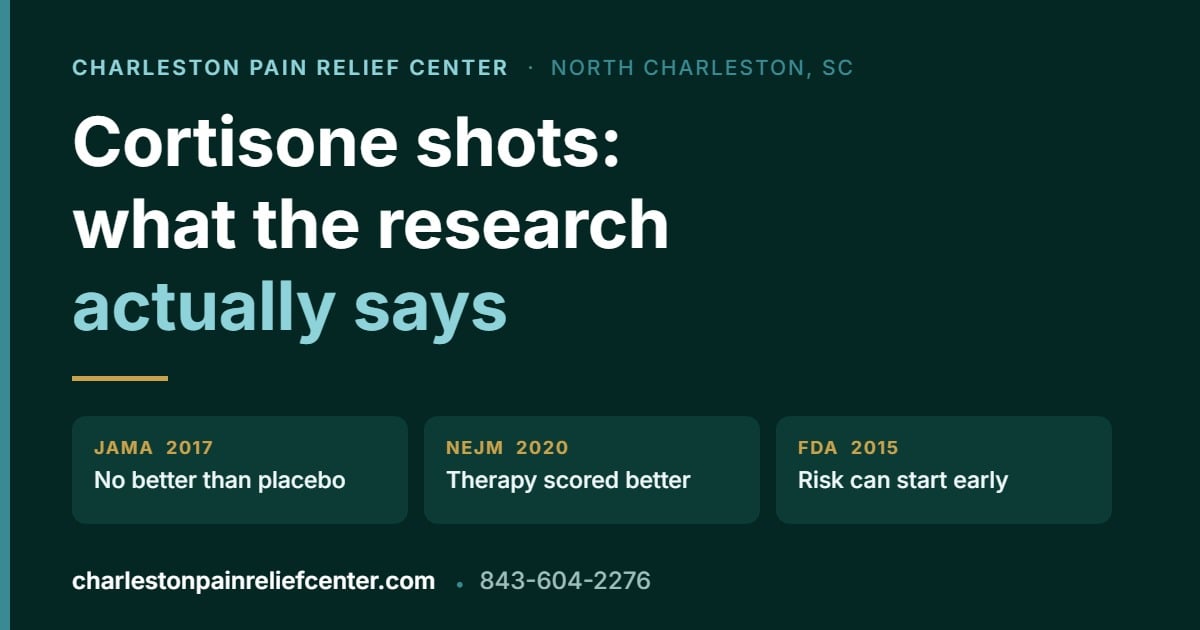
A randomised, double-blind clinical trial published in JAMA in 2017 followed 140 people with knee osteoarthritis for two years. One group received a triamcinolone (cortisone) injection every three months; the other received saline. The result: the cortisone group had significantly greater cartilage volume loss, and no significant improvement in pain compared with the placebo. The authors concluded the findings “do not support” this treatment for symptomatic knee osteoarthritis.
2. Injection versus conservative physical care
In 2020 the New England Journal of Medicine published a head-to-head trial of 156 patients: glucocorticoid injection versus structured physical therapy. At one year, the physical-therapy group scored 37.0 on the WOMAC pain and function index versus 55.8 for the injection group — a lower score means less pain and better function. Hands-on, conservative care outperformed the shot at the twelve-month mark.
3. Joint complications that rarely get mentioned
Radiologists at Boston University reviewed their injected patients and published the findings in Radiology in 2019 under the title “Perhaps Not as Safe as We Thought?” They described four categories of adverse outcome: accelerated osteoarthritis progression, subchondral insufficiency fracture, osteonecrosis, and rapid joint destruction with bone loss. Roughly 8% of the patients they reviewed had a complication. Their recommendation was that these risks be added to consent forms so patients actually know about them.
4. Anti-inflammatories: the label changed for a reason
In July 2015 the FDA strengthened the warning on non-aspirin NSAIDs — the ibuprofen and naproxen family, prescription and over-the-counter. The agency acted on data showing the risk of heart attack or stroke can rise within the first weeks of use, with estimates of increased risk ranging from roughly 10% to 50% or more depending on the drug and dose. NSAIDs also carry well-documented gastrointestinal bleeding and kidney risks with sustained use.
To be fair: this does not mean “never”
A cortisone injection can be the right tool. It can break a pain cycle badly enough that someone can sleep, move, and start rehabilitating. Anti-inflammatories have a real place too, especially short-term. The issue is not that these exist — it is that they are often used repeatedly, for years, as the whole plan, when the evidence says they work best as a short bridge to something that changes the tissue. Ask your provider two questions: how many of these am I likely to need, and what is the plan that makes the next one unnecessary?
What we do instead in North Charleston
Our approach is conservative, drug-free and non-surgical, and it is aimed at the structure causing the pain rather than the pain signal alone. Under one roof at 2294 Otranto Rd:
- SoftWave shockwave therapy — acoustic waves that stimulate the body’s own repair response in tendon, joint and soft tissue.
- Class IV laser therapy — light energy used to calm inflammation and support cellular recovery.
- PEMF therapy — pulsed electromagnetic fields to help recharge cells and support healing between sessions.
- Spinal decompression — for disc-related back and neck pain and the nerve symptoms that come with it.
- Regenerative medicine — PRP and related options for joints that need more than symptom control.
- Red light therapy and chiropractic care to support the whole recovery.
Most patients we see have already tried the shots. That is usually why they call.
Frequently asked questions
Are cortisone shots bad for your joints?
Not automatically — but repeated injections carry real risk. The 2017 JAMA trial found greater cartilage loss with quarterly knee injections over two years compared with placebo, and a 2019 Radiology review reported complications in about 8% of injected patients, including accelerated osteoarthritis. Occasional use is a different question from years of repeat injections.
How many cortisone injections are too many?
There is no single agreed number, which is part of the problem. The more useful question is whether each injection is buying you time to fix something, or simply postponing the same conversation. If you are on your third or fourth in the same joint, it is reasonable to ask what else is available.
Is it safe to take ibuprofen every day for pain?
Daily long-term use is where the risk accumulates. The FDA strengthened its warning in 2015 because heart-attack and stroke risk can begin early in treatment, and sustained use also carries stomach-bleeding and kidney risks. Anyone taking anti-inflammatories daily should be having that conversation with their prescriber rather than managing it alone.
What are the drug-free alternatives to cortisone injections?
Options that target the tissue rather than the signal include SoftWave shockwave therapy, class IV laser, PEMF, spinal decompression for disc-related pain, structured conservative care, and regenerative medicine such as PRP. In the 2020 NEJM trial, structured physical care outperformed the injection at one year.
Where can I get drug-free pain relief near North Charleston?
Charleston Pain Relief Center is at 2294 Otranto Rd, North Charleston, SC 29406, serving North Charleston, Hanahan, Goose Creek, Ladson, Summerville, Park Circle and the wider Lowcountry. Call or text 843-604-2276.
Been offered another shot? Get a second opinion first.
Tell us what hurts and what you have already tried. Our North Charleston team will text you back with a straight answer about whether we can actually help — and what it would involve.
Sources
- McAlindon TE, et al. Effect of Intra-articular Triamcinolone vs Saline on Knee Cartilage Volume and Pain in Patients With Knee Osteoarthritis: A Randomized Clinical Trial. JAMA. 2017;317(19):1967–1975.
- Deyle GD, et al. Physical Therapy versus Glucocorticoid Injection for Osteoarthritis of the Knee. N Engl J Med. 2020;382:1420–1429.
- Kompel AJ, Roemer FW, Murakami AM, Diaz LE, Crema MD, Guermazi A. Intra-articular Corticosteroid Injections in the Hip and Knee: Perhaps Not as Safe as We Thought? Radiology. 2019;293(3):656–663.
- U.S. Food & Drug Administration. Drug Safety Communication: FDA strengthens warning that non-aspirin nonsteroidal anti-inflammatory drugs (NSAIDs) can cause heart attacks or strokes. July 9, 2015.
Medically reviewed by Kayla Blann, FNP-C
Charleston Pain Relief Center · 2294 Otranto Rd, North Charleston, SC 29406 · 843-604-2276 · Last updated 5 August 2026. This article is educational and is not a substitute for individual medical advice. Do not start or stop any medication without speaking to your prescriber.