
Short answer
Most sciatica gets better. Most people recover fully from sciatica caused by a herniated disk, often without treatment, and most cases improve within a few weeks of non-surgical care. Surgery is usually reserved for disabling leg pain that lasts three months or more despite non-surgical care, or for emergency signs.
Which treatments speed recovery up is less settled. One trial found active spinal manipulation relieved acute sciatica pain more than a simulated treatment. A Cochrane review found that traction, the family spinal decompression belongs to, probably has no impact on pain or function in people with sciatica. And a Cochrane review of low-level laser for low-back pain found too little data for firm conclusions.
At Charleston Pain Relief Center in North Charleston, SC, we start with an exam to work out what is driving your leg pain, and we will tell you plainly if you should be seen by a medical provider instead.
This article is general information, not medical advice for your situation. Do not stop or change a prescribed medication on your own — talk with whoever prescribed it first.
Pain Relief · North Charleston
What is actually causing your pain?
Text yourself the answer: what we would look at, what it costs, and this week’s openings. One tap, and the message is already written for you.
★ Your first 15 minutes are free
Prefer to talk? Call 843-604-2276

Scan it with your phone camera
The message is already written. Send it and we reply with the details.
On your phone right now? Call 843-604-2276
Where the research in this article comes from
We would rather you check our numbers than take our word for them. The patient-level facts in this article come from the sciatica guides published by Mayo Clinic, the American Academy of Orthopaedic Surgeons and Cleveland Clinic. On the treatments we offer, three studies matter most: a 2006 randomized, double-blind trial of 102 people with acute sciatica from a disc protrusion; a 2013 Cochrane review of traction for low-back pain with sciatica; and a 2008 Cochrane review of low-level laser for low-back pain. Full citations are at the end. From here on we will refer to them as the patient guides, the 2006 trial and the Cochrane reviews.
What is sciatica?
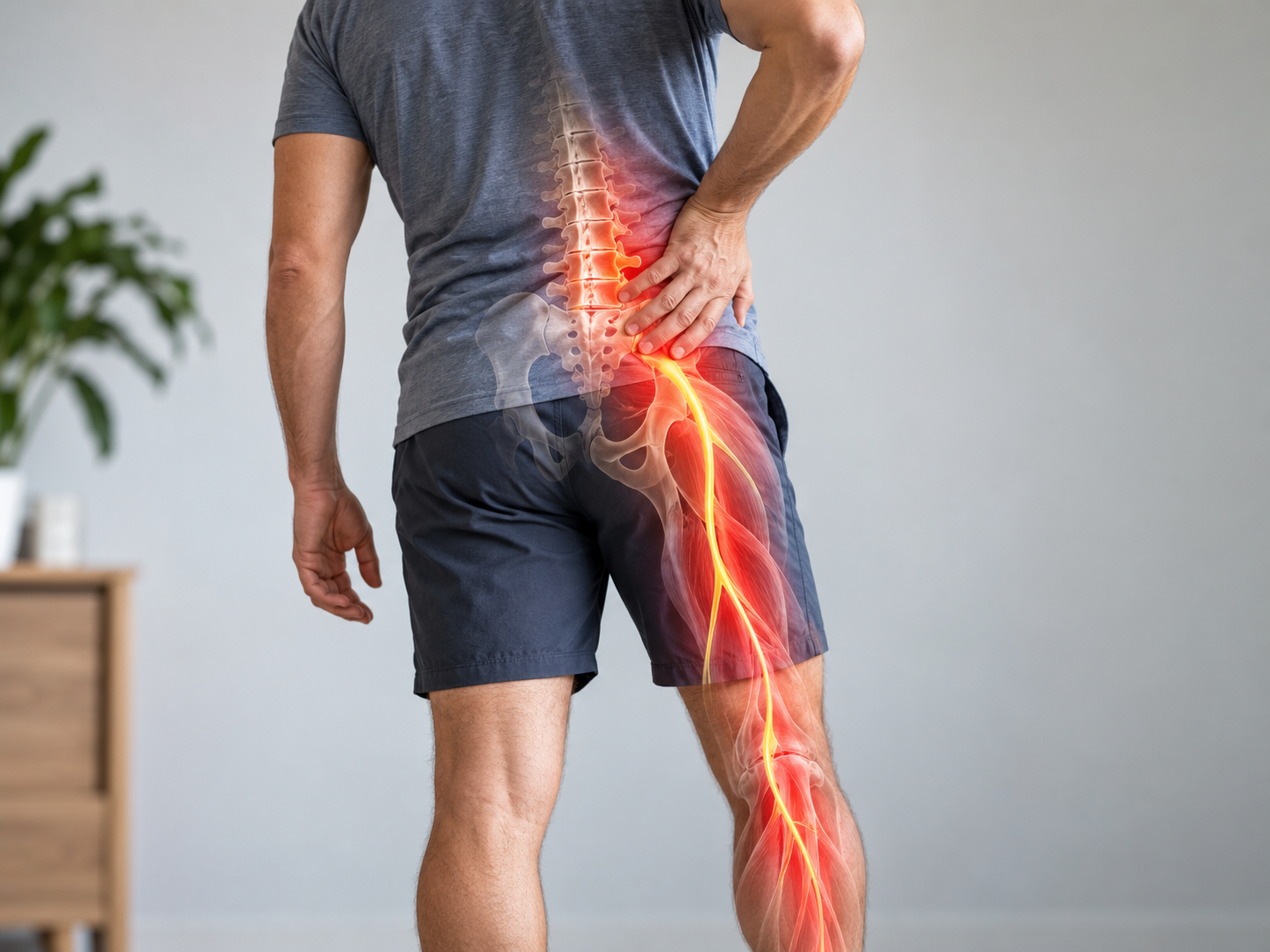
Sciatica is pain that follows the path of the sciatic nerve: from the lower back through the buttock and down the leg, usually on one side. It is a broad label for nerve pain rather than a single diagnosis. There is “true” sciatica, where something directly affects the sciatic nerve, and “sciatica-like” conditions that feel similar but have other causes. Part of our job is telling the two apart.
What causes sciatica?
Sciatica most often happens when a herniated disk or a bone spur presses on a nerve root in the lower spine. The nerve becomes inflamed, and you feel it as pain and often numbness down the leg. Younger adults are more likely to have a disc problem behind it; older adults are more likely to have bone spurs and arthritis. You can read more about herniated discs and back pain treatment on our site.
Risk factors include age (disc problems are most common between 20 and 50), extra body weight, jobs that involve twisting, carrying heavy loads or driving for long periods, sitting for long stretches with little movement, and diabetes, which raises the risk of nerve damage.
Common sciatica symptoms
- Pain that runs from the lower back or buttock down the back of the thigh and calf, usually on one side
- Pain that ranges from a mild ache to a sharp, burning pain, sometimes like a jolt or electric shock
- Pain that gets worse with coughing, sneezing or sitting for a long time
- Numbness, tingling or weakness in the leg or foot; one part of the leg may hurt while another feels numb
Red flags: get medical care right away
Most sciatica is not an emergency. Get medical attention immediately if you have sudden numbness or muscle weakness in a leg, pain after a violent injury such as a car accident, or trouble controlling your bowels or bladder. Numbness in the groin or inner thighs along with leg pain is another emergency sign, because it can point to cauda equina syndrome. If pain lasts longer than a week, is severe or is getting worse, contact your doctor.
Non-surgical treatment options for sciatica
Treatment depends on the cause, and the first steps are usually simple. The patient guides advise starting stretching exercises as soon as possible so you can return to normal activity, and they list pain medicines and physical therapy as common treatments, with steroid injections around the nerve root in some cases. Here is what we know about the options we offer at CPRC.
Chiropractic care
Chiropractic care uses spinal adjustments to restore motion and reduce irritation around the nerve. In the 2006 trial, active spinal manipulation relieved pain more than simulated manipulation, and no adverse events were reported. It is one small trial of acute cases, so it does not tell us how manipulation compares with other treatments or how well it works for long-standing sciatica.
Spinal decompression
Spinal decompression is a form of traction: a computer-controlled table applies a gentle, controlled stretch with the aim of easing pressure on discs and nerves. The 2013 Cochrane review found low- to moderate-quality evidence that traction probably has no impact on pain, function or overall improvement in people with sciatica compared with sham or no treatment. That review covered traction in general rather than any one brand of table, so it does not settle the question for every device. It is a reason to treat decompression as something to try with clear checkpoints, not as a guaranteed fix.
Class IV laser therapy
Class IV laser therapy delivers high-power light to the sore tissue to calm inflammation and support healing. The 2008 Cochrane review of low-level laser for non-specific low-back pain reported small short-term pain relief that was not clinically important and concluded there were insufficient data for firm conclusions. That review covered low-level lasers and low-back pain, not Class IV devices or sciatica specifically, so it cannot settle the question for either. It does mean nobody should promise you results.
Other supportive therapies
We also offer other therapies, such as PEMF therapy. Ask us how they would, or would not, fit your case before you commit to a plan.
When surgery is considered
- Emergency signs such as loss of bladder or bowel control or numbness in the groin or inner thighs.
- Significant leg weakness. Severe sciatica with significant leg weakness or bowel or bladder changes may need surgery.
- Disabling leg pain that has not improved after three months or more of non-surgical care.
Whether surgery is right for you is a medical decision, usually made with imaging and a surgeon. If you have been told you need it, a second opinion is reasonable.
What a sciatica plan may look like at CPRC
- Exam and history, including a check of leg strength, sensation and reflexes, and a review of any imaging you have.
- A plan that fits the cause, which may combine hands-on care with other therapies.
- A reassessment partway through, so you and your provider can see whether it is working.
- A referral when it makes sense, for example if you have red-flag symptoms or are not improving.
Frequently asked questions
How long does sciatica last?
It varies. Sciatica from a herniated disk usually clears within weeks to months with treatment, and most cases improve after a few weeks of non-surgical care. If your pain lasts longer than a week, is severe or is getting worse, contact your doctor.
Is bed rest good for sciatica?
Not for long. Start gentle stretching as soon as you can, and keep rest to a day or two before returning to slow, controlled activity.
Can a chiropractor help with sciatica?
The 2006 trial found active spinal manipulation relieved acute sciatica pain more than a simulated treatment. That is encouraging but limited, and a chiropractor should also screen you for red flags and refer you out when needed.
Does spinal decompression work for sciatica?
The evidence is not strong. The 2013 Cochrane review found that traction probably has no impact on pain or function in people with sciatica, though it did not test any one brand of table. Ask any provider offering it what result to expect and by when.
What should I do if I have sciatica and lose bladder or bowel control?
Go to an emergency room right away. Do not wait for an appointment.
Where can I get sciatica treatment near North Charleston?
Charleston Pain Relief Center is at 2294 Otranto Rd, North Charleston, SC 29406, serving North Charleston, Hanahan, Goose Creek, Ladson, Summerville, Park Circle and the wider Lowcountry. Call or text 843-604-2276.
Sciatica not improving? Get a second look.
Tell us where it hurts and what you have already tried. Our North Charleston team will text you back with a straight answer about whether we can help — and what it would involve.
Sources
- Mayo Clinic Staff. Sciatica: Symptoms and causes. Mayo Clinic. mayoclinic.org
- American Academy of Orthopaedic Surgeons. Sciatica. OrthoInfo. orthoinfo.org
- Cleveland Clinic. Sciatica (page updated February 10, 2026). my.clevelandclinic.org
- American Academy of Orthopaedic Surgeons. Herniated Disk in the Lower Back. OrthoInfo. orthoinfo.org
- Santilli V, Beghi E, Finucci S. Chiropractic manipulation in the treatment of acute back pain and sciatica with disc protrusion: a randomized double-blind clinical trial of active and simulated spinal manipulations. Spine J. 2006;6(2):131–137. record
- Wegner I, Widyahening IS, van Tulder MW, Blomberg SEI, de Vet HCW, Brønfort G, Bouter LM, van der Heijden GJ. Traction for low-back pain with or without sciatica. Cochrane Database Syst Rev. 2013;(8):CD003010. PubMed
- Yousefi-Nooraie R, Schonstein E, Heidari K, et al. Low level laser therapy for nonspecific low-back pain. Cochrane Database Syst Rev. 2008;(2):CD005107. Cochrane summary
Charleston Pain Relief Center · 2294 Otranto Rd, North Charleston, SC 29406 · 843-604-2276 · Last updated 3 October 2026. This article is educational and is not a substitute for individual medical advice. Do not start or stop any medication without speaking to your prescriber.